God's Protection

Monday, October 14, 2013

One of our hens, Lark, recently hatched 6 adorable chicks.  None of our hens over the years have had much success with hatching eggs because most are easily distracted and move from one nest of eggs to another.  But Lark picked a nest in the back corner of one of our buildings a stayed there for weeks.  Her persistence paid off!  Now Lark is extremely protective of her chicks, pecking anyone who gets too close and defending her chicks from all ostensible dangers with her feathers puffed out to look twice her size.  

Everyone knows how vicious mother bears can be in defense of their cubs, and my poor dog learned a long time ago how frightening a mother cat's claws can be when she is defending her brood from potential intruders.  The defensive-mother instinct is one of the most powerful instincts of nature.

God cares about us even more than Lark cares about her chicks.  In fact, he loves us more strongly than even human mothers love their own children.  Isaiah 49:15 says, "Can a woman forget her sucking child, that she should not have compassion on the son of her womb? yea, they may forget, yet will I not forget thee."  He is our defense and our help when we are in trouble.  The Bible says, "When the enemy shall come in like a flood, the Spirit of the Lord shall lift up a standard against him."  

In the book of Matthew, Jesus cried, "O Jerusalem, Jerusalem, thou that killest the prophets, and stonest them which are sent unto thee, how often would I have gathered thy children together, even as a hen gathereth her chickens under her wings, and ye would not!"  The Lord is looking for someone who will trust and believe Him.  Jerusalem of old times rejected and crucified their Savior.  Do not reject His love.  "The eyes of the Lord run to and fro throughout the whole earth to show himself strong on the behalf of those whose hearts are perfect toward Him."  We make mistakes, but no matter what our problems may be, God is greater; He doesn't make mistakes.  Claim His promises, walk in His ways, and trust in His guidance and protection.

"He that dwelleth in the secret place of the most High shall abide under the shadow of the Almighty...
He shall cover thee with his feathers, and under his wings shalt thou trust." --Psalm 91:1&4

Treasures of Small Town Iowa

Thursday, October 10, 2013

When we make deliveries of the concrete pads we sell for propane tanks, we often like to take country roads which lead us through small towns. 

Every area of the country has its own secrets which only locals know.  In our neck of the woods most everyone knows that "Lonny's" is where all the farmers go to drink their coffee, swap stories, and eat peanuts; the thrift store behind Subway is the best place for bargain shopping; my dad's shop is where to have welding done; the blue pick-up truck belongs to so-and-so, etc.  But outsiders are clueless (and my dear readers would still be lost trying to discover these local secrets from the tips above without additional help from locals).  


While we certainly haven't cracked the enigmas of any of the small towns we drive through, we have skimmed the surface to discover a few of the small town treasures.

Rhodes, Iowa has a population of 305 and was founded in 1803.  Driving through the town, we wondered what treasures it held.  As we neared the center of the town we saw a tank!

The Vietnam era tank  (pictured above) was placed on display  in the early 1990s.  The treads of the tank reach to a height of about 5 feet.  During the Vietnam War, the tanks would plow through vegetation, leaving paths behind them which troops could follow without having to cut their way through the jungles.  At the park and veterans' memorial where the tank sits, we met Jerry, who as a member of the city council helped arrange for the tank to be moved to Rhodes.  He explained to us that the tank was now welded shut, but in the case of a national emergency the welds could be removed and the tank could be put back into service.  

I didn't get any good full-body shots of the tank, so here's one from randomiowa.com
Another town we drove through is State Center, the Rose Capital of Iowa.  State Center is a slightly larger town with a population of 1,468.  Some of the flowers in the Rose Garden were starting to fade, but enough of the roses were vibrant enough for it to still be a photographer's heaven!

A park bench


And such is the beauty of small town and country life!  

Around the World to Bosnia

Wednesday, October 9, 2013

This is the first of a series of Around the World Wednesday essays giving a brief history & overview of countries around the world.  While browsing through old notebooks, I found this essay I wrote several years ago on Bosnia-Herzegovina which, revised and updated, will serve as the first post of this series.
Psalm 46:8-10
"Come, behold the works of the Lord, what desolations he hath made in the earth.  He maketh wars to cease unto the end of the earth; he breaketh the bow, and cutteth the spear in sunder; he burneth the chariot in the fire.  Be still, and know that I am God:  I will be exalted in the earth."

Begin at point 0,0.  Travel 43 degrees, 52 minutes north and 18 degrees, 25 minutes east; you will find yourself in Southeastern Europe, in the Balkan Peninsula, north of the Adriatic Sea, to the east of Croatia, with Serbia and Montenegro to your east and southeast respectively.  You will be in Sarajevo, Bosnia.  Bosnia-Herzegovina, at 19,971 square miles--less than half the size of Iowa--claims 7 major rivers, several waterfalls, 16 miles of shoreline on the Adriatic Sea, one of the two surviving ancient European forests (which covers half of the country), and a 13th century fortress.  Yet, this small, beautiful land has often been racked with wars and horrors.
Ostrozac Castle via Wikipedia
History
Formed in 1189, Bosnia lost its independence to Ottoman Empire conquest in 1527.  In 1908 it was annexed by the Austrian-Hungarian Empire.  In 1914, a Serbian patriot named Gravilo Princip assassinated Archduke Ferdinand, heir to the Austrian-Hungarian throne, and his wife in Sarajevo.  This sparked World War I, a war which claimed approximately 7 million lives, but left Bosnia virtually untouched.  After the war, Bosnia and Herzegovina joined the South Slav Kingdom of Serbs, Croats, and Slovenes (Yugoslavia).
Meeting of Chetniks and other guerrilla groups during World War II in Bosnia
Yugoslavia was invaded by Germany on April 6, 1941, and Bosnia was ceded to the Independent State of Croatia.  Croat leaders undertook to exterminate Serbs, Jews, Communists, Antifascists and others in death camps.  Between 80,000-100,000 people were murdered in the Jasenovac extermination camp alone.  Many Serbs joined the Chetniks, a guerilla resistance group.  The Bosnian terrain provided ideal conditions for resistance.  As Basil Davidson wrote, "Bosnia was the geographical mother of the partisan movement, providing ample space amongst its mountains for training and development."  The Chetniks fought both the Nazis and the multi-ethnic Communist Partisans lead by Tito and eventually backed by the Allies.  After the end of the war, Bosnia and Herzegovina become one of the 6 constituent Republics of the Socialist Federal Republic of Yugoslavia under Tito.

In 1990, Yugoslavia began to break apart as Croatia and Slovenia declared independence.  The Serbs in Bosnia preferred to stay with the Yugoslav federation, but the Bosniaks and Croats wished to declare independence.    In 1992, Bosnia split into the Serbian Republic of Bosnia and Herzegovina (Republika Srpska) and the Croatian Community of Herzeg-Bosnia.  The Constitutional Court of Bosnia and Herzegovina declared Herzeg-Bosnia illegal.

After a referendum for independence from Yugoslavia--boycotted by Serbs--in which 99.7% of the 63.4% of people who voted voted for independence, Bosnia and Herzegovina declared independence.  On April 6th, open warfare began in Sarajevo.

Secret discussions, known as the Karadordevo agreement, between Serbia and Croatia on the division of Bosnia and Herzegovina had been held as early as March 1991.  Following Bosnia's declaration of independence, the Serbs attacked.  The state administration of Bosnia effectively ceased to function, having lost control of its entire territory.  The Serbs wanted all lands mostly populated by Serbs.  The Croats also aimed at expanding their territory at the expense of Bosnia and Herzegovina.  Bosnian Muslims were the only ethnic group loyal to the Bosnian government.

Republika Srpska soon had most of the country under its control.  Bosniak houses and apartments were ransacked or burnt and Bosniak civilians were captured, beaten, and killed.  Families were separated and massacres and atrocities were committed.  Serbian forces undertook an ethnic cleansing campaign, and thousands were murdered in the Srebrenica genocide in 1995.  In Sarajevo, children were a primary target for snipers, and according to one survey, after all the atrocities the children witnessed 90% claimed they did not even want to live.  The Serbians were finally pushed back after a NATO bombing campaign and a ground offencive by the allied forces of Croatia and Bosnia.  In December 1994, the signing of the Dayton Agreement in Dayton, Ohio by the presidents of Bosnia and Herzegovina, Croatia, and Serbia brought a halt to the fighting.  Over 100,000 soldiers and civilians of all ethnicities had been killed.

Government 
Today, Bosnia and Herzegovina is a federal democratic republic with a bicameral legislature and a presidency consisting of three members: one Serb, one Bosnian, and one Croat.  An international civilian implementation overseer or High Representative, though not a government member, has authority to dismiss elected and non-elected officials.

Suffrage is universal.  The voting age is 18; however, 16 and 17 year-olds can vote as well if they are employed.
A Waterfall on the River Una
The People and Culture
Bosnia has a population of 3,875,723.  Of these, 48% are Bosniak, 37.1% Serbs, and 14.3% Croats.  Bosnian and Croatian are both official languages.  The citizens of Bosnia are also divided into various religious groups: 40% are Muslims, 31% Orthodox, 15% Roman Catholic, and 14% of various other persuasions.

49% of Bosnians live in cities and towns. The agricultural sector, which accounts for 19% of the GDP, does not produce enough food to meet the needs of the country; so some food must be imported.

Bosnia's GDP is $32.43 billion.  Bosnia's main industries are steel, coal, iron ore, lead, zinc, manganese, bauxite, vehicles, textiles, tobacco products, furniture, tanks, aircraft, oil refining, and domestic appliances. There is 44.6% unemployment, and 18.6% of Bosnians live below the poverty level.  The GDP per capita is estimated at only $8,400.  The public debt is 43.8% of the GDP. (See CIA World Factbook)

Bosnia has 98% literacy rate.  It also has a rich culture in art, music, theater, and literature.  The country also hosted the 14th Winter Olympics in 1984.

Men usually shake hands upon meeting, but among the Muslims it is forbidden for women to shake hands with men unless they are related.  Families are most often patriarchal.  Bosnians generally do not look each other in the eye when speaking, but look aside to promote concentration on the theme discussed.  Guests always bring a small gift when visiting the homes of friends.   Bosnians are known as friendly and hospitable people.

Tourist Attractions
Sarajevo is home to many museums including the National Museum of Bosnia and Herzegovina (established 1888), the Ars Aevi Museum of Contemporary Art, the Alija Izetbegović Museum, and the Museum of Sarajevo.

Bosnia is also noted for its ski slopes.  Modern resorts, inexpensive passes, and reliable snowfall between December and March make it a fun for ski enthusiasts.

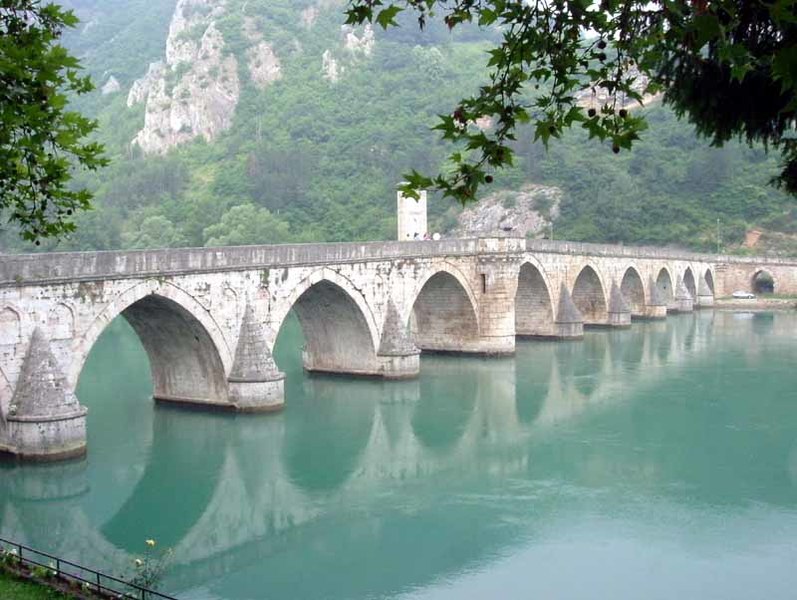
Visegrad Bridge via Wikipedia
Other interesting locations include the Shrine of Our Lady Medjugorje, the Mehmed Paša Sokolović Bridge in Visegrad, Mostar "the City of Sunshine," the Kastel fortress, Una National Park and the waterfalls of the river Una, Sutjeska National Park (home to Bosnia's highest peak and beautiful native forest and the location of a great battle of World War II where the Partisans defeated a massive German army), the Kravica Waterfalls, Ostrozac Castle, Jajce (city of the Bosnian kings), Doboj and its 13th century fortress, Konjic and Tito's underground nuclear bunker, and the Lower Tara river canyon (the deepest in Europe).

Mostar via Wikipedia
Bosnia is a historical treasure trove, which though often racked by conflict, has shown its resilience through the ages.

What God Does is Forever

Monday, October 7, 2013

"For ever, O Lord, thy word is settled in heaven.  Thy faithfulness is unto all generations: thou hast established the earth, and it abideth.  They continue this day according to thine ordinances:
 for all are thy servants."  --Psalm 119:89-91

One of my favorite Bible verses is Ecclesiastes 3:14, "I know that, whatsoever God doeth, it shall be for ever: nothing can be put to it, nor any thing taken from it: and God doeth it, that men should fear before him."  There is much uncertainty in this world.  We never know from one day to the next whether we will be in a car accident, if there will be another mass shooting, or if some struggle in the Middle East will explode.  But there is one thing that we do know, Jesus is the same yesterday, today, and forever.  He is our Rock of Ages.

Hebrews says, "Thou, Lord, in the beginning hast laid the foundation of the earth; and the heavens are the works of thine hands: they shall perish; but Thou remainest; and they all shall wax old like a garment; and as a vesture shalt Thou fold them up, and they shall be changed: but Thou art the same, and thy years shall not fail."  God is dependable; He is always there for us, no matter how the world falls apart.  

No one can stop God from fulfilling His plan  in your life.  Trust Him, and do not worry; His plan for you is good.  Corrie ten Boom, a survivor of Ravensbruck concentration camp, would often hold up the back side of an embroidery to audiences.  She explained that while we sometimes may only see what looks like a tangled mess in our lives, God can see the beautiful side of the embroidery all the time.  Someday we will be able to see everything beautiful from His vantage too, and we will thank Him seeing us through every trial.  Trust Him; He is faithful.

Civil War Reenactment

Thursday, October 3, 2013

Sunday morning, September 8th, we left home at about 8:50 to drive to Mason City, Iowa to see a Civil War Reenactment.  The drive was, thankfully, uneventful.  We stopped at an auction on the way, as we had heard that postage stamps were to be auctioned.  The stamps were common--no thousand dollar finds--so we finished our trip to Mason City.
We arrived in time to chat with our friends the Dirksens (who had kindly invited us) and the Lenz sisters, whom I had heard speak at a ladies conference this spring.  Then the South Carolina regiment infantry drills began.  After watching the troops prepare for the battle, we walked over to the concession stands, conveniently situated in no-man's land (between the Southern and Northern camps) and obviously owing allegiance to neither side.


We bought quesadillas at a Mexican food trailer and delicious root-beer at Doc's (below right)


The tent on the left sold reenactment memorabilia: swords, hats, handkerchiefs, post cards, etc.

While we ate we listened to this couple play civil war songs.  

The Northern Camp--isn't the blue dress that the lady in the background is wearing beautiful?

After taking a quick look at the field hospital below, I decided I didn't want to be injured in any battles.

Cannons, including this one, guarded the banks of the Southern camp.

We took seats in the grass across the creek from where the battle would be held.  Soon the Southerners and Northerners bravely marched onto the battle field.


The Southern Army preparing to fire.


Northern Artillery.  Both the Southern and Northern cannons were *very* loud!


The first Southern soldier fell, and the Northerners began advancing


But the situation didn't really get bad until a  group Northern soldiers slipped across the creek, breaking up onlooker's "picnics" and outflanking the Southern army.


Onlookers watched as the North continued advancing and the South continued retreating.


Soldier after Southern soldier boy fell until with a final cannon blast their final escape route was closed and the Southern army lay dead and wounded on the banks of the lake.  The North won again.

And everyone returned to their camps.  

"What a cruel thing is war; to separate and destroy families and friends, and mar the purest joys and happiness God has granted us in this world; to fill our hearts with hatred instead of love for our neighbours, and to devastate the fair face of this beautiful world! I pray that, on this day when only peace and good-will are preached to mankind, better thoughts may fill the hearts of our enemies and turn them to peace."  --Confederate General Robert E. Lee

Time to Harvest Apples!


"A word fitly spoken is like apples of gold in pictures of silver"--Proverbs 25:11

It is said that Sir Isaac Newton developed his theory of gravity when an apple fell on his head. After seeing as many apples as I have seen (and felt) fall, one would think I would have attained a much greater level of enlightenment in the past month!

Our crew of 6 has picked six bins (about 4000 pounds of apples) in about 4 hours for a local orchard on several days.  How fast we pick depends on how selective the picking is and the size of the trees.  Our current record is a bin in 20 minutes.  We have had fun learning the basics of fruit picking (how to keep the apples from bruising and how to empty a fruit-picking sack). 

While Sir Isaac Newton only had to watch for falling apples, we discovered orchards should post signs reading "Beware of Falling Mice."  My sister once reached up and picked an apple and noticed what looked like a very messy nest on it.  The apple was not in good shape, so she dropped it.  A few minutes later I heard someone mention an animal in the tree...and then someone said, "Bethany, watch out!"  I cleared out of the way, and lo and behold, there was a mother mouse with a half dozen tiny mice clinging to her--*up in the tree!*  Poor mouse, the apple had been her home.  She scurried down and then made successive trips until her whole brood was assembled on the ground.  So much for Beatrix Potter's mouse that lived in a shoe...living in an apple ripening in a tree beats them all!  The mouse could have been given an award for ingenuity if she hadn't overlooked the problem of some hungry person *picking* the apple.  (No need to worry next time you bite into an apple--our apple picker's union guarantees you will not find any mice). 

We picked Cortland, Jonathan, McIntosh, and Wealthy apples.  The Cortlands are the largest--and extremely filling (they seem best for slicing or apple pies).  Meanwhile, Jonathan apples are small, making a perfect lunch-box apple.  This year has been an excellent year for apples, so the 1400 or so trees that fill the orchard are completely loaded!

Apple Ridge Orchard makes delicious, award-winning apple cider, and their pies are quite tasty too,  so if you're ever nearby be sure to make your own visit to the apple orchard!

Weathered Wood

Tuesday, September 3, 2013

"Cast me not off in the time of old age; 
forsake me not when my strength faileth."  --Psalm 71:9

My family has an old house on our property which no one has lived in for years.  Several years ago, we stripped the siding and gave the house a fresh new coat of white paint.  

Many frigid winters, hot summers, and strong winds have passed.  We have had floods and droughts.  Today, as you can see above, the house is once again in dire need of a new paint job.  The wood siding is weathered and the paint is falling off.

To start with, we are all like wood with a fresh coat of paint.  We are young and beautiful, full of hope, perhaps sophisticated.  But then the wind of adversity starts blowing; it tests our true strength. Sometimes it seems the whole cruel world fights us, beating with indomitable waves and persistent raindrops. Time takes her toll.  When the veneer wears off, what is left?

Only the interior wood is left, whether it is lovely or ugly.  The siding above is an eye-sore without the paint, but some people work for hours to remove paint from oak trimmings in their homes. 

God looks beyond the surface and see our hearts.  We can hide bad character traits from others, but we can hide nothing from God.  We will give an account for our lives before his Judgment Seat.  
When youth is past, when we are old and gray, when our bodies are laid in the grave, after the winds have blown and the storms have beat upon us, what will be left?

Will we be ugly siding without paint, or will we be beautiful oak, finally breathing freely; transformed and set at liberty from our vessels of clay?
DESIGNED BY ECLAIR DESIGNS