My Centenarian

Monday, November 12, 2012

     There's a little white church a couple miles from my home, with a little old cemetery beside it.  Drive in the gate and you'll find a headstone that reads: "Esther Pitts 1900-2009, A Life of Giving."

     October 31, 2009 was her last birthday. We had 2 days of celebrating--a party with friends on the 30th, and then a party with just the family on the 31st--during which we consumed 3 cakes.  I guess eating 3 cakes was nothing--when Aunt Esther was young she would eat a pound of chocolate on the bus on her way home from work.   


Aunt Esther lived with my family from December 2002 (when I was 8 and she was 102) until she died in December of 2009.  Believe me, living with a woman nearly a century older than I was a very interesting experience!

I met Aunt Esther when I was very young (that's me with my mother, Aunt Esther, and the rabbit ear TV, which by the way is sitting on a rack for phonograph records).  My father had known Esther since 1974, and she had shown many kindnesses to my family and many others (A Life of Giving). 
But my first memory of her is actually a memory of me sprinting down the hallway, an elderly lady in a wheelchair, dark hair pulled back neatly, at my heels, determined not to let me leave without giving her a hug!  Over the next few years I was to learn that love is the purest gift, the freest gift, the most needed gift, and that love doesn't run away.
As Aunt Esther's latest caretaker faced ill health, in 2002, my parents "kidnapped" Aunt Esther from a rest home in La Grande, OR. Spirited across the Rockies in our old Ford Ranger, Aunt Esther joined us in Iowa. My siblings and I had the time of our lives wheeling Aunt Esther around the house, showing her where all the light switches were. Then we settled down for a delicious bowl of steaming vegetable soup. To our surprise, Aunt Esther wanted peanut butter on her soup.  It wasn't long before we caught on to the splendid idea of peanut butter on everything--soup, oatmeal, raisin bran, chocolate, pie, and ice cream. I even took Aunt Esther's ideas a bite further and tried peanut butter on salad--not the brightest combination.
Aunt Esther's scrap books were fascinating, and her stories were too--until we had heard them the umpteenth time.  She told us of how her mother fainted when she saw a woman smoking for the first time (in the 1920's), and of how her mother threatened to make her wear a hat in the house if she ever cut her hair (she said she never even wanted to).  When she was a girl, women were arrested if they wore pants in public. She was born before Wilbur and Orville Wright invented their first "flying machine" (airplane) and before the Titanic sunk.   She received post-cards from her cousin who fought in France during World War 1, but didn't remember the Great Depression very well because both she and her brother kept their jobs during the Depression and didn't face financial difficulties.  
Aunt Esther and co-workers in front of the Laundry where she worked.
  She is tall, wearing a dark sweater, and standing in front of the
"5 Thrifty Services" sign.
She told us of the shortage of alarm clocks during World War II, and how after her alarm clock was stolen she had a friend who had a clock call her so she could wake up and get to work in time.  She was a living history book although a great part of her stories were stories that she had read here or there.  She loved animals, particularly cats, and liked to tell stories of cats that had done extraordinary feats.  My dad has told various stories of Esther when she was younger.  Once a preacher came to town, ran up a bill at the local grocery store, and left town without paying the bill.  All over town people talked about what hypocrites these so-called Christians were.  Aunt Esther walked to the grocery store and payed the bill.  I'm sure she did many other good deeds that no one living now knows of.
While she lived with us, Aunt Esther was hard of hearing and had a voice that could shake the cedars--a good thing if she needed help, a bad thing when she had phantom pains in her amputated leg or argued with my parents. She could be heard from the attic to the basement. Aunt Esther had dementia and because of this seemed to love arguing. One evening when arguing was worst, I went outside to escape the scene and bring in the laundry, and I found that God's great peace is always available for His children, regardless of the circumstances. I also developed an allergy for arguing because, while simple disagreement is good for both sides, repeating "I'm right and you're wrong" one hundred times and in a hundred different ways really convinces a person of nothing but "I'm right and she's wrong!" I learned that one must forgive and forget, because an unforgiven deed develops bitter poison, and time does not heal. Sometimes our dear Aunt Esther would sit up crying about some unkind deed someone had committed 70 or even 100 years before!  
I learned that work is valuable and brings great satisfaction and fulfillment. Though "resting" was one of Aunt Esther's favorite pastimes, too much resting did Aunt Esther no good, and my parents knew it. In the summer, Aunt Esther would hull beans and peas, and shuck corn--and she enjoyed it. In the winter, Aunt Esther would complete laps around the house in her wheelchair, dropping a canning jar lid into an empty oatmeal container as she completed each lap. She also did other exercises. If she kept moving, regardless of her complaints, "This wheelchair is killing me!" and "torture!" she stayed healthy and strong.
By God's grace, Aunt Esther did stay alive and strong for 7 years, telling everyone, "I'm glad I still have most of my marbles!" Nearly every night as I grew from a little 8 year-old to a studious 15 year-old I'd shout "Good night, Aunt Esther, I love you!" sometimes give her a hug, and bound up the stairs. Living with a centenarian was difficult at times, but I'm glad my parents "adopted" Aunt Esther. I learned a lesson of extreme love and patience from my parents and valuable lessons about forgiveness and work from Aunt Esther, and I acquired an undying taste for peanut butter. 
 A sign over Aunt Esther's desk read, "Only one life, 'twill soon be past; only what's done for Christ will last." Even in her senile years, Aunt Esther was a blessing. 
What advice would Aunt Esther give you if she were alive today?  "Do all the good you can while you can, because you never know how soon it will be too late!"  (and yes, I can still hear her intonation of the phrase ringing in my ears as I type).  It's the same advice she gave everyone, and it's true. 
 God calls us to follow him today.  Hebrews 3:15 says, "Today if ye will hear His voice, harden not your hearts." Today is the day of salvation.  Today is the day to make a difference in this world.  If we wait till tomorrow, it may be too late.

Purr-sistence (Persistence)

Friday, November 9, 2012

Skippy
A couple years ago, a stray and very wild tabby Felis Catus moved to our acreage.  We named her Skippy (She's also known as Zippy) because she would zip (or skip, or run, or whatever means was fastest) away at the sight of Homo Sapiens.  We thought she'd never make a good pet.  She was a seemingly hopeless case.  My dad, however, thought differently.  He started feeding her.  By and by, she would allow us to come within 4 feet of her.  Next, she let us scratch her head while she ate.

Today, she sits on the patio (preferably on a comfortable chair on the patio), waiting for us to come out.  Sometimes she begs to be petted; she especially enjoys being scratched under the chin. She purrs, and my sister reports that Skippy has even sat on her lap.  She's a changed cat.  If we (or particularly my dad) had given up on the cat after the first week or two, she would never have become the sweet, playful, domesticated kitty she is today.  Purrsistence, or rather persistence,  payed off. 

But watch out, you might get swatted!
     G.B. Shaw once said, "When I was young I observed that nine out of every ten things I did were failures, so I did ten times more work."

 Most everything is difficult when you first start, but as you persist in your efforts, not only does your work become easier, but also better quality.  

When my dad started his welding business, he had a customer maybe once a month.  A decade later, he rarely has a day when he's not busy working in his shop.  Sometimes 3, or 4... or 5 jobs are brought in in one day, and it's not unusual to see farm equipment parked outside waiting to be worked on.  

When I first started sewing,  it was a headache.  I seemed to take out more stitches than I put in.  But it's almost impossible to find the kind of skirts I like to wear for sale, so I sewed 1 skirt, and then another.  Half a year later, I sewed another just to remind myself how much I dislike sewing.  For my first 5 big sewing projects, crooked seams, days of frustration, 3 or 4 tries before installing a zipper correctly--only to have it break within a week--and the like were the norm.  A couple weeks ago my wardrobe was boring me enough, so I dutifully visited a fabric store and picked out a couple yards of denim.  A few hours in my free-time during 2 days, and ta-da!  Near-perfect hems, a zipper done correctly the first time (and better than any of my others), straight lines for all 10 panels, and exactly the style of flared skirt I like.  I still hate sewing, but believe me, persistence pays off and practice makes perfect.

Often, thinking about doing something can be the hardest part.  When you really decide to get something done, focus on it, and dive into the task, usually you'll find it easier than you had feared.

  Last month, I decided I needed to be able to run a half mile without difficulty.  At the time, I was quite winded after running a quarter mile.  With a little practice, by the end of the month I could run a whole mile with less trouble than I could run the quarter mile at the beginning of the month.  Imagine how hard that would have been if I had just spent the month thinking about it!   

Driving is another example.  When a person is learning, trying to drive without swerving all over the road, failing to look in the rear-view mirror before slowing down, and almost being hit by the car behind him/her can be a nerve-wrecking experience.  With practice, however, the student gradually becomes more relaxed and skilled.  

But, if you're learning to drive, I recommend you take your cat along.  Persistence pays off, but you may need all 9 lives if you want to live to see it.  

On second thought, the cat might be a driving distraction when she climbs up on the dash.  Maybe what we all need is a guardian angel.

We the People...

Thursday, November 8, 2012

          When we walked out of our car to the polling place, the local public library, it was early morning.  As we signed up for our ballots, one of the election officials--whom we all know from the Republican caucuses-- asked us "Is it still raining?"  We said, "Yes."  He said, "Good!" 

      He didn't need to say anymore; we knew exactly what he meant.  Republicans (supposedly) are more determined voters and a little rain wouldn't stop them.  There's always a little humor when it comes to getting the right people out to vote (and encouraging the wrong people to stay home).  In the 2008 Republican caucus here in Iowa, Mike Huckabee told his supporters, "If you've got friends or neighbors that won't vote for me, put all your snow in their driveway and don't let them out tomorrow night."  It must have worked, as Huckabee won with a 9% lead over his nearest opponent.
A little bit of snow in the driveway here in Iowa can sometimes be a big problem, as this photo from February 2010 shows. 
     Perhaps Republicans would vouch for moving the election to January for better chances of snow, except many Democrats also show determination to have their voices heard--as demonstrated by this woman who made her way to the polls even though she was in labor.

I was a little surprised that I wasn't required to show any identification (but Voter ID laws aren't in effect here and everyone knows each other anyway).  My name was in the registered voters book, so I just signed the book, gave my address, was given a ballot, and proceeded to a voting booth.  

I filled in the easy ovals first.  Iowa State Representative Pat Grassley is a decent Republican, and he had no candidate running against him. 

U.S. Representative Steve King was running against former Iowa First Lady Christie Vilsack.  They've both had energetic campaigns.  Yard signs for King or Vilsack decorate many lawns and I've received many phone calls asking which of the two I like better.  Steve King ranks in my top 10 of politicians.  I was very impressed listening to him at a town hall meeting a couple months ago, so he, of course, got my vote.  I was happy to see him win with 55% of the vote, as opposed to Vilsack's 43%.

On the back side of the ballot was the option of voting "yes" or "no" on retaining Iowa's Supreme Court Justices.  In 2010, 3 of the justices were voted out after the Iowa Supreme Court unanimously ruled to strike the words from the Iowa Code which limited marriage to the union of a man and a woman.  Iowa became the first Midwestern state allowing homosexual marriage.  This year, the vote on whether or not to retain Justice Wiggins was seen an important gauge of whether or not most Iowans still protest the homosexual marriage ruling or have now come to accept homosexual marriage as a norm.  To my dismay, Wiggins kept his position with 54% of the vote.

Here in Iowa, we had minor presidential candidates from the Constitutionalist, Libertarian, Green Party, Party for Socialism and Liberation, and Socialist Workers' Party, as well as an independent on the ballot, besides Republican candidate Mitt Romney and Democratic candidate President Barack Obama.  Many of the names of these minor candidates were unfamiliar to me; I imagine their election night hopes were as forlorn as Thaddeus McCoter's hopes were at the Ames Straw Poll in August where he played his electric guitar and finished with 0.2 % of the votes.  (I don't know what his stand was on important issues; I do know that I disliked his music!)


This Facebook meme epitomized the presidential election from my perspective.

     As Noah Webster wrote:  Good intentions will always be pleaded for every assumption of authority...the Constitution was made to guard against the dangers of good intentions.  There are men in all ages who mean to govern well, but they mean to govern.  They promise to be good masters, but they mean to be masters."  

Both the Republican and Democratic parties have dramatically increased the size of government at the price of individual liberty within my lifetime.  Under Republican President George Bush we saw the creation of the Department of Homeland Security, the TSA, the TARP bailouts, the Patriot Act, and 2 wars which have cost us thousands of American lives as well as the lives of many innocent civilians in the Middle East.  With Barack Obama, we have the Affordable Care Act (Obamacare), the $787 billion American Recovery and Reinvestment Act, the NDAA, and the auto-industry bailots.

Obama supports homosexual marriage.  In May of this year he said, "I've just concluded that for me personally it is important for me to go ahead and affirm that I think same-sex couples should be able to get married."   Obama also supports abortion, or "a woman's right to choose."  As I am pro-life and strongly believe in traditional marriage, voting for Obama was out of the question.

Romney, on the other hand, declared in a 2011 GOP primary de-bate: "I believe people understand that I'm firmly pro-life. I will support justices who believe in following the Constitution and not legislating from the bench. And I believe in the sanctity of life from the very beginning until the very end."  In a 2007 GOP debate, Romney said, "I’d like to see Roe v. Wade overturned and allow the states to put in place pro-life legislation."  This is a drastic change since Romney said in a debate with Ted Kennedy in 1994: "I believe that abortion should be safe and legal in this country; I have since the time that my mom took that position when she ran in 1970 as a U.S. Senate candidate.  I believe that Roe v. Wade has been the law for 20 years, that we should sustain and support it, and I sustain and support that law and the right of a woman to make that choice."

 I found it incredibly difficult to vote for a presidential candidate who has "flip-flopped" on some issues, and whom I suspect may have changed positions on some issues just to please voters.  I can't vote for a man I don't more or less trust.  Additionally, I am not a fan of Romney's foreign policy.

I can't see why the Republican party chose the one of all the candidates in the primaries most like Obama.  Why did they choose the author of Romneycare, a program which was used as a pattern for Obamacare, to run against Obama?  To me, it was a borderline absurdity.

Neither candidate even promised to audit the Federal Reserve, cut various departments and agencies which I consider part of an overgrown, expensive bureaucracy, give young people the choice of opting out of social security without being treated like second or third class (or dead) citizens, or make the drastic changes needed to help our economy get back on its feet..

  So, to the dismay of both my Republican and Democratic friends, I wrote in Ron Paul.  Regardless, My county was won by Romney in nearly a landslide.

Perhaps I am die-hard, perhaps a bit stubborn, but I couldn't bring myself into voting which ice-burg our ship of state should hit.

The absurdity of so many of the laws and policies in these United States irks me daily and occasionally haunts my dreams.  Unfortunately, I don't believe either candidate would have changed the situation drastically for the better.

All I can say is, Oh God, deliver us from the shackles of what has become this gargantuan bureaucratic inferno of archaicness, degradation, oppression, and hypocricy that crushes in the bud so much of the nascent vitality of our people.


I'm disappointed that my fellow citizens chose to re-elect President Barack Obama.

If "We the People" have decided to adopt the new sport of crashing-into-iceburg derbies in an attempt to sell our birthright of liberty, become dependents on our government and not freemen, and enslave ourselves with debt, it would have broken up the monotony at least to hit a different ice-burg.

I'm a Trillionaire

Saturday, October 27, 2012

Yes, I am now a trillionaire!  I invested less than 30 dollars, did no work, and waited less than a week.  I promptly received the return on my investment: a total of $260,000,000,000,000  issued by the Reserve Bank of Zimbabwe in 2008. 

The problem with this rich quick scheme?  It's only paper.

Zimbabwe hyperinflation reached it's peak in 2008-2009.  Hyperinflation was preceded and caused by droughts, a large national debt, the redistribution of wealth, and "uncontrolled government spending."  Read more at the Dallas Federal Reserve's website.

Would you like to be a trillionaire like me?   You can for 1 cent plus $4.99 shipping and handling  (here)  or (if you're interested in hundreds of trillions) here or here.

But if you're hungry, I recommend you skip this investment and use your 5 dollars to buy a Whopper at Burger King instead.  Don't invest in something that can quickly lose its value with the whims of politicians.  Invest in something real that has inherent value--be it sandwiches, businesses, gold, silver, or oil...because, well, you can't eat paper.

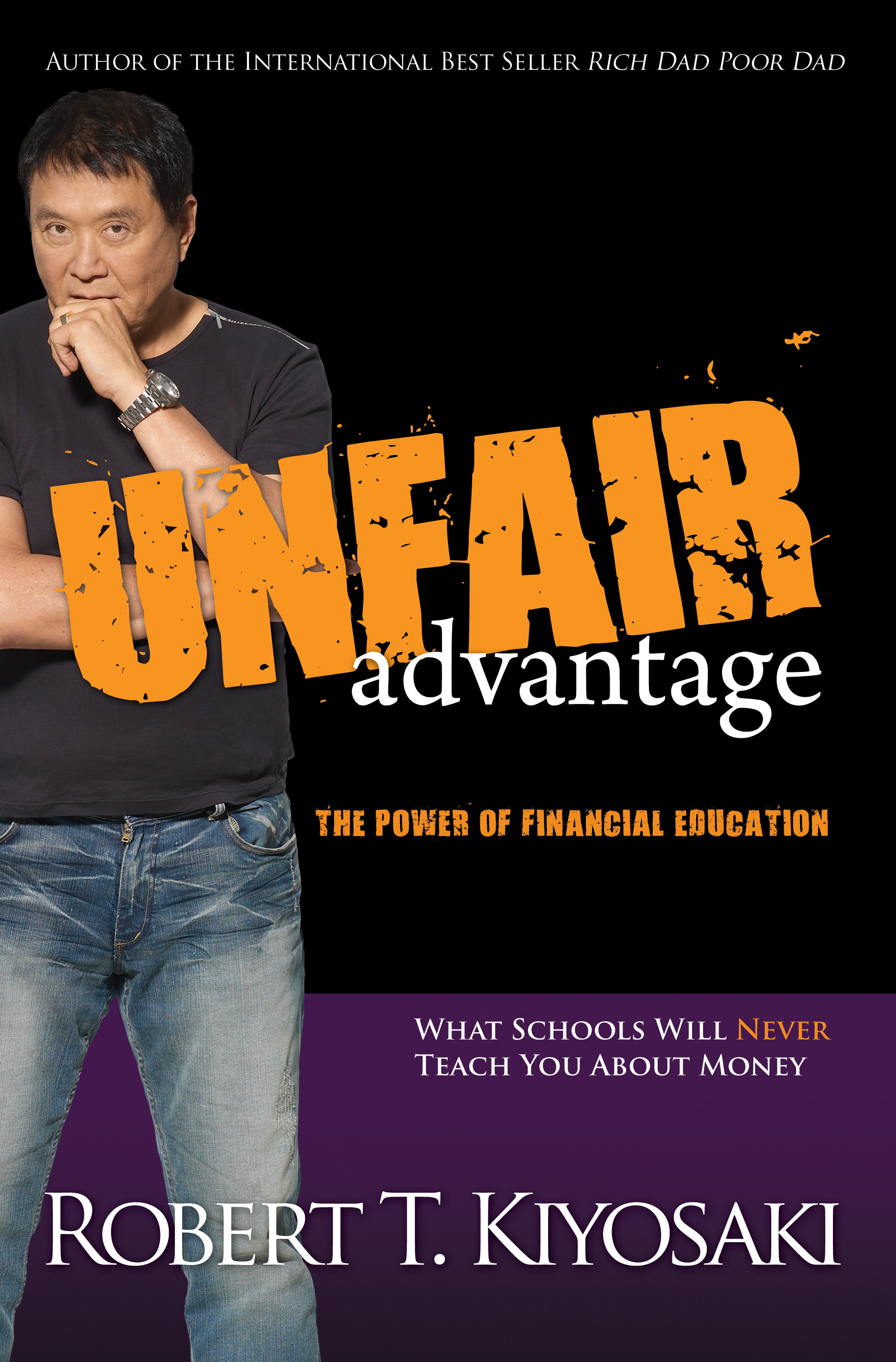
Book Review: Unfair Advantage

Wednesday, October 17, 2012

     A friend recently suggested that I read Unfair Advantage: The power of financial education, by Robert Kiyosaki of RichDad.com, author of NY-Times best-selling Rich Dad, Poor Dad.  The book is 176 pages long, and the Kindle version can be purchased for only $9.85.  I found the book very thought-provoking, challenging many of the most commonly held beliefs of our time.  My only complaints are a few typing errors and a few mild slang expressions the book would have been better without.  The book was well worth its price, and I would definitely recommend it.  

Information Age v. Industrial Age
Kiyosaki claims that the Industrial Age ended with the birth of the world wide web ,and the Information Age has begun.  For those still clinging to outdated Industrial Age ideas about going to school, job security, steady paychecks, early retirement, saving money, assets & liabilities, and government support, Kiyosaki predicts the next few years will be the worst of times.  If you want to be free, he says, it is necessary to let go of old ideas.  "For those who are financially educated, prepared, flexible, and adaptable, the next 10 years will be the best of times.  For those who are waiting for the happy days of the past to return, the next 10 years will be the worst of times."  In the Information Age, Kiyosaki says financial education (not training)  is essential.

Assets v. Liabilities
Kiyosaki's definition of assets and liablities is quite different than anything we learned in accounting class.  To him, anything that brings cashflow in is an asset and anything that sends cashflow out is a liability.    For example, he considers his house a liability because he has to pay taxes and insurance on it and pay for its upkeep (cash flows out).  He considers the apartment building he owns and rents to tenants an asset because after all the expenses are paid he has a net income from the rent he is paid (cash flows in).  "Assets put money in your pocket, and liabilities take money from your pocket."

Saving Money
Saving money, according to Kiyosaki, is a bad idea.  Why? because since the United States went off the gold standard during Nixon's presidency, money hasn't been real money.  Why save money when the government is always printing more?  Kiyosaki believes higher taxes and inflation are coming, and the U.S. dollar could even collapse.  Since 1971, he says, the dollar has lost 95% of its purchasing power, and it won't take 40 years to lose the remaining 5%.  Instead of saving paper, he recommends that those who have a limited financial education save real money (gold and silver).  "If our leaders do a good job, gold and silver will decline in value.  If our leaders are incompetent, gold and silver will go through the roof" (Take your bet :P).  For the financially sophisticated, he recommends using debt to acquire "assets."  He also recommends investing money for cash-flow.

Investing
"Nothing is a good investment if you are a bad investor," Kiyosaki says.  First of all, he believes sending money to others to invest for you (in mutual funds, etc.) is a bad idea.  He believes 401k's are a very bad choice.  "Mindlessly sending your money to complete strangers is not the end result of good financial education.  It is the end result of dog training." Cash flow is the most important word when it comes to investing.  "Cash is always flowing.  It is either flowing in, or it is flowing out.  True financial education trains you to have cash flow in."  He invests primarily for cash flow, not capital gains; and he likens investing mainly for capital gains to gambling.  "We invest in investments that require people to send us money, good economy or bad," he claims.  For example, people always have to have a place to live, so he invests in apartments, and his tenants send him rent whether the economy is up or down.  People always need gas for their cars, so he invests in drilling.  His focus is on acquiring assets that will work for him, so people will always be sending him money.  He also believes in having a diversified portfolio.  But the typical "diversified portfolio" is what he calls a "de-worsified  portfolio" because most so-called diversified portfolios only contain a variety of paper assets--so they are "less worse" but not diverse.  For him, a real diversified portfolio has investments in different asset classes--real estate, businesses, paper assets, and commodities.  This book contains advice on reducing risk in various investments.   

Education
"The real financial crisis is a crises of an educational system that is old, obsolete, and out of touch with the real world," Kiyosaki asserts, "One of our biggest problems is an antiquated educational system that hangs on to the past and cannot see the future.  It's an obsolete system that insists on preparing students for a world that is dead and dying."  Traditional education teaches people to become employees and small business owners.  These students will work hardest and pay the most taxes (if they are able to find jobs at all).  Kiyosaki says schools change too slowly while the world changes too fast and claims that to solve the financial crisis, more true capitalists are needed.  To become a big business owner or investor, it's best to have instructors from these quads.   What he considers most important in an education is the skills learned, who the teachers are, and how the education prepares a person for the real business world.  He goes to seminars and lectures, hires coaches, learns from his mistakes, and believes financial education is essential, especially for the uncertainty of the world ahead.  ROI for Kiyosaki stand for a Return on Information.  "This means the more information I have, the higher my returns--and the lower my risk."  He claims that life-long learning, and good teachers, coaches and friends are the key to success.  

Financial Freedom
     Kim Kiyosaki, Robert's wife, writes in his book that "Shifting [her] focus to acquiring assets took the attention off me working forever for my money, and put it on [her] money working forever to make money." Every year they set their goals...they were looking for financial freedom.  "Financial freedom to Robert and me was not amassing millions of dollars in savings on which to live.  It was simply to have the cash-flow coming in every month from our investments, whether we worked or not," she wrote.  She said they were always learning.  They achieved their goals and financial freedom, and went from being homeless, in bad debt, and living in a friend's basement, to being multi-millionaires.  


A Motivational Book
"Your brain is your greatest asset.  Your brain can also be your greatest liablility," Robert Kiyosaki says  .  Kiyosaki forecasts a coming financial storm/crisis and a "crash of nations".  He gives advice for the reader, depending on where they are in life, and urges the reader to "Learn more so you can do more.  Focus on doing more with less, and enriching the lives of others.  Your job is to use your unfair advantages to put the power of financial education to work in your life.  First change yourself.  Then change the world."

So, that's my summation of Unfair Advantage's 176 pages.  If you, like me, are pondering whether some of his ideas are good or bad, practical or impractical, it's time for you to start reading.  Kiyosaki expresses his ideas cleverly and keeps the book alive with stories from his own experiences.  He also had his wife and a few experts on taxes and investing write segments of the book.  Most importantly, Kiyosaki keeps the reader engaged and thinking about what improvements he/she can make in his/her own life.  If you're up to some unconventional and surprising reading which may challenge you to look twice at some of your own beliefs, this book is for you!


Hike Around Upper Pine Lake

Saturday, October 6, 2012

We decided to take the trek around Upper Pine Lake.  

The trip started with a detour down a steep trail and a rickety ladder to take a look at one of our favorite spots on the Iowa River.


Then, we went on to Pine Lake, 
starting on the same nicely paved trail we used to walk around the lower lake.


The upper lake was beautiful with autumn colors.
We glanced at the spillway, which was still dry as a bone, and then headed up this path

(My parents)

Until we came to a fork in the road


The right path leads around the lower lake, and the left path leads to an adventure around the upper lake, so we chose the upper lake.

The going was still easy...a leisurely stroll on a decent path...but it was only a decent path for a while.


Remnants of an old bridge

To cross this bridge we would have needed wings.  
Fortunately for us, though, the water was gone too.  This is what our path looked like next:

If you can't see the path, I can't blame you

We ran down some hills (slid down the ones that were too steep) and crawled up others.  We also spotted about 4 deer.

Finally, we saw the rock dam which keeps silt from the stream from flowing into the lake.
There was some talk of walking across the rock dam like we did this winter.  But the decision was out-voted by the majority of people, who were not interested in getting their shoes and socks wet.

We left the woods behind and reached a dilemma.  How were we to cross the stream that feeds the lake?

The answer:

Jump onto an over-hanging tree branch and walk over!


There was a SPLASH...and it's a good thing there are no piranhas around.

Our courageous scout accidentally slipped into the creek just as he was landing on the other side.  He jumped out of the water, dripping wet from the waist down. 

I waited to see how the others would fair; with my brother's help on the other side, everyone made it safely.  So, I crossed second to last...

and, fortunately, I made it without mishap.


  A dinosaur egg?  Nope, it's a  mushroom.

Our path became less than pleasant on the other side of the lake.  We had to stoop to get through brush, and sticker bushes and cockle-burs wouldn't let us forget their presence.   

But the fun wasn't over yet.  Next we crossed a little swamp/wet-land.  So, everyone who didn't have wet socks yet soon had them.  I was wearing rubber boots, which I thought would keep my feet dry, but unfortunately I stepped in one spot where the water was too deep. We all faced the same fate.

We hiked through another wooded area and then came to another grass/wet-land.  This one was, except for one small stream, dry.  But we were in for a big surprise.  My brother took a step and stopped.  Not more than 6 feet away from him, a giant wild turkey jumped out of the grass and flew away.  I couldn't resist thinking what a good Thanksgiving dinner that turkey would have made.

We walked through a stretch of pine trees, over a couple creeks,and under and over dead logs, and  acquired more cockle-burs in the wood-lands and brush.
Our pathway... 

Papa found an arrow an archer had lost.  Then finally we glimpsed civilization through the trees!


Our hike was over, and we were very glad to get back to our van for glasses of water and refreshments.

   In my post "Gone Hiking: This Land is Mine" I wrote, "I know from experience that the route around the upper lake is not for the faint in heart."  Well, it isn't, but it's certainly a lot of exercise and a lot of fun.

Let's Whip Up a Batch of...Concrete!

Friday, October 5, 2012

 Today instead of whipping up a batch of cookies, we're mixing concrete.  I'll give you the recipe and a view of our latest concrete job.

What you will need:
1 part Type 1 Portland Cement
 (how much a part is depends on how much concrete you want to make, 
1 part could be 1 teaspoon, 1 coffee can, 1 bucket, or 1 ton. 
 Just be consistent and keep the proportions right; proportion is the important part.)


2 Parts Sand

                   
3 parts rock  (We use a mixture of gravel and pea gravel... 
2 parts gravel and 1 part pea gravel does the job).

Make sure your rock and sand is clean.  Dirt, sticks, and leaves would make the concrete weaker.

For a small operation like ours, a wheelbarrow is a great for mixing the concrete in.  So, we pour 1 part cement, 2 parts sand, and 3 parts gravel/pea gravel into a wheelbarrow.


Next, grab a shovel and mix the dry ingredients.

Add a little less than 1 part water.


Mix thoroughly.

This mixture is rather wet, your mixture should appear slightly drier.

After the concrete is thoroughly mixed  (everything should be gray and you should not be able to see any sand), you can put the concrete to work.

We make concrete pads for propane tanks, so we pull out our forms, grease them with oil (to make the finished concrete pads slip out easier), and set them on a work table.


The forms are filled about 3/4 full with concrete.  Then the re-bar goes in.  


The forms are filled completely, and then smoothed with a finishing trowel.
  
Next the concrete should be vibrated, but if you don't have a vibrator handy--we don't--move the form to the edge of the work table and bounce the form 50 times up and down.  
Concrete after vibration (shaking)
The forms are then carried to the rack seen in the photo so that the table can be used for other projects.  My sister grabs the finishing trowel and re-finishes the concrete, adding extra where it is needed so the forms are full and the concrete is smooth.


The concrete is then left to dry in the forms for a few hours (the exact number of hours depends on weather conditions.  If it is hot and dry the concrete dries more quickly).  When the concrete looks solid, it is moved in the forms into large tubs of water to be cured.  


Water curing is one of the most effective methods of curing concrete.  It retains moisture so that the concrete can become stronger and it delays shrinkage until the concrete is strong enough to resist shrinkage cracking.  


After a day (2 days in cold weather), the concrete is taken out of the forms.  The concrete pads are placed back into the water for about a week.

The finished product:


DESIGNED BY ECLAIR DESIGNS