Showing posts with label Individual Liberty. Show all posts

Geese at Pine Lake

Wednesday, December 24, 2014

This fall my family and I went biking in the Pine Lake/Iowa River area and enjoyed watching the geese on the lake.  
Many seemed to have characters all their own.  A dear old friend of mine used to say "We're not all made from the same cookie-cutter!"  Wouldn't the world be a boring place if we were?  Apparently geese don't all come from the same cookie-cutter either.

Stand up to the Devil

Sunday, April 13, 2014

"For he that hath, to him shall be given: and he that hath not, 
from him shall be taken even that which he seemeth to have."  --Mark 4:25

     A lot of things in life are affected by the snowball effect.  The rich seem to get richer; the famous get more fame.  And the talented get more opportunities to increase their talent.  This is not at all bad, but unfortunately it works the other way too.

If you let one person (or government) knock you down or discourage you, others will know you are vulnerable and knock you even further down.  The spirits of fear, laziness, worry, and doubt are just like alcohol: addictive.  Don't yield yourself to them.  Resist evil and be strong.  

Another lesson I learned from my chickens:  Hens who were picked on by the others developed a spirit of fear.  They'd start clucking fearfully and run away whenever another chicken walked by them.  It didn't matter whether they were bigger or stronger; they were scared!  If they had stood up for themselves they might have had a chance, but sadly fear ruined their lives.

Romans 6:16 says, "Know ye not that to whom ye yield yourselves servants to obey, his servants ye are to whom ye obey; whether of sin unto death, or of obedience unto righteousness?"  Don't let bad habits get a hold of you.  

Waking up at a decent hour is easy for someone who has done so day after day for the past year, but for someone who has said, "Yet a little slumber, a little folding of the hands to sleep!" for the past week, it may be almost impossible.  Getting a job done is easy for someone who is diligent, but for someone who is lazy it may seem like climbing Mt. Everest.

Just like we must stay physically fit by exercising our muscles, we must exercise our will power every day and face the challenges before us.   We must face our bad habits, our fears, our enemies, and every evil that comes against us.  We must stand up to the devil!  If we cower, we may get nothing done in our lives.  We will be just like a poor scared chicken, buffaloed by everything.  But as the saying goes, "Where there's a will there's a way!"  It may be hard at first, but it will get easier as we establish good habits.  The Bible says resist the devil and he will flee!  With God all things are possible.

Defiance

Tuesday, January 7, 2014

Hebrews 11:23 tells us, "By faith Moses, when he was born, was hid three months of his parents, because they saw he was a proper child; and they were not afraid of the king's commandment."  Pharaoh, King of Egypt, the most powerful man in the world at that time, had ordered that all male Israelite children be killed.  Did Moses' parents meekly obey the law of the land and let the government kill their child?  No!  They defied the king's decree.  They knew there is a higher law, the Law of God.  

Many times when we ask why we should or should not do certain things, the only explanation given us is, "It's the law."  In an episode of the Would You Fall for That? show, the staff once dressed authoritatively, placed a divider on a footbridge, and held a sign saying all brunettes had to walk on one side and all blondes on the other side.  Most people obeyed the orders without question.

In an episode of Candid Camera, the staff walked into an elevator with a man and all faced backward, pretty soon the man was facing backward too.  The staff took their hats off and he did the same; he followed every motion everyone else did, trying not to be conspicuous.


People are trained to be conformists.  But just because a government or authority says something is right doesn't make it right.  Just because everyone else does something doesn't mean it's the correct thing to do.  At the Nuremberg trials many Nazis used the excuse "I was just following my superior's orders" to explain the crimes which they committed against humanity.  This excuse was not deemed valid.  Every person is responsible for his or her own actions.  

We were not created just to "follow orders" and do what everyone else is doing.  We must think for ourselves and weigh the laws of man using the ethical scale provided by the Bible, our moral compass.  Evil people (and governments) call evil good and slander the good as evil.  We need to keep our eyes open and be willing to defy ungodly authority and stand up for what is right.

The heroes and heroines of history have not been those who lackadaisically watched the sunset as their principles blew across barren fields like tumbleweed, turning one way and then another with every gust of wind.  The heroes have been those who stood firm in their beliefs, those who would rather die than compromise, and those who lived not for themselves, but for God and posterity.  

Don't be afraid to challenge injustice.  Place your faith in the Word of God (Jesus Christ), defy evil, and even if you are the only one who does, stand up for the truth.     

Book Review: Government Bullies

Wednesday, December 4, 2013

I've enjoyed reading several of Ron Paul's books, so when I decided it was time to purchase a new book to read on my Kindle, I decided to try his son Senator Rand Paul's 2012 publication, Government Bullies: How Everyday Americans are Being Harassed, Abused, and Imprisoned by the Feds.  

Government Bullies is available in hardcover (320 pages) and paperback formats as well, but the Kindle format is very convenient--no pages blowing in the wind when I read outside, and I can easily carry it in my purse to read anywhere, between rounds at a chess tournament or sitting in the car on a road trip. 

 The format of the book is consistent.  To each part there is an introduction, in-depth stories of grievances, and a section about what can be done to solve the problem.  The style is informal; it's not a literary masterpiece, but is a lot like the way I imagine Senator Paul would talk if he were giving a speech or addressing constituents.  


Part 1 address EPA Bullies.  Paul points out that EPA regulations cost more than 5% of our annual GDP, and is equivalent to the costs of defense and homeland security combined.  People have been sent to jail for 3 years for moving dirt onto their own property.  One woman, her father, and engineer were sent to jail by the EPA for violating wetland laws on her property when her land was so dry it didn't even flood during Hurricane Katrina.  Wetland regulations and the Clean Water Act need to be clarified so that the EPA and Army Corp of Engineers do not abuse property openers.

Part 2 concerns the Lacey Act, a law which has been expanded over it's more than 100 years of existence so that the United States can prosecute people and companies for violating foreign laws.  Gibson Guitars was raided by both the Department of Homeland Security and Fish and Wildlife armed agents and SWAT teams for allegedly using "endangered" wood from Madagascar to make guitars.  Many guitars, materials, and equipment were confiscated.  

In another case, Paul writes that a lobster fisherman's 70,000 lb. shipment of lobsters was confiscated because of a tip from an anonymous caller.  The fisherman was prosecuted by the U.S. government on violating three Honduran regulations: 1. Lobster tails cannot be less than 5.5 inches long (3% of the shipment was), 2.  Lobsters cannot be egg-bearing (7% were), and 3. Cardboard boxes must be used for shipping (he use clear plastic bags.)  No charges were brought against the man in Honduras, and the Honduran government later informed the U.S. that the cardboard box regulation had been repealed in 1995, the egg-bearing regulation had been repealed retroactively, and the lobster tail length regulation was never signed into law.  However, the fisherman in question, dubbed "the ringleader of the smuggling operation" by press releases, was given an 8-year sentence and was still in a federal prison at the time of the publication.  

Part 3 describes the abuses of the TSA: naked body scanners, intrusive pat-downs, sexual molestation, rampant abuse, humiliation of the elderly and ill, theft and overall corruption.  Paul claims that the TSA doesn't make us completely safe, but rather less free.   Paul recommends an Air Traveler's Bill of Rights to protect against TSA abuses.  But he believes the best solution is to end the TSA and privatize airline screeners.  Airlines have a vital interest in making sure their passengers are safe, and it would be bad business for them if they treated their passengers disrespectfully.  

Rand Paul also decries sending foreign aid to countries which are not friends of the United States or which detain or hurt U.S. citizens.  In fact, he says, borrowing money from the Chinese to give as foreign aid to other countries makes no sense at all.

Part 4 explains that though the FDA and USDA were formed with good intentions and indeed have necessary roles in the government, they too have expanded out of proportion, raiding even small Amish farmers selling "illegal" raw milk.  "Isn't it insane to think that in America someone could be arrested for the 'crime' of drinking milk directly from the cow?" Paul asks.  Another family in Missouri that started a small rabbit business to give entrepreneurial experience to their teenaged son was threatened by the FDA with a $3.9 million fine because they had violated a mysterious law that prohibited selling more than $500 worth of rabbits in one year (they grossed $4,600 which provided a $200 profit which they used to eat out at restaurants a few times).  
___________________________

The stories presented in Government Bullies will not give you sweet dreams, so I do not recommend the book as bed-time story material.  I do recommend it, however, to anyone who is not aware of the many injustices committed by the government.  Rand Paul's goal in writing the book is to promote liberty activism and inform the public of the outrages happening every day in this country.  For those who already understand the infernal depths of bureaucracy, this book will feed the fires of the soul burning with zeal against the injustices of the government.  

I shall conclude with a friendly reminder--be sure you read the 4,450 federal crimes in U.S. code and 10,000's of regulations before going about your daily tasks.  Otherwise you may find yourself a criminal like the individuals mentioned above, facing years of imprisonment, armed government raids, and multimillion dollar fines for selling milk, bunnies, rosewood guitars, and lobster tails.   

Anyone miss the good ol' days of the Ten Commandments?

The Role of Religion in Political Campaigns

Tuesday, November 12, 2013


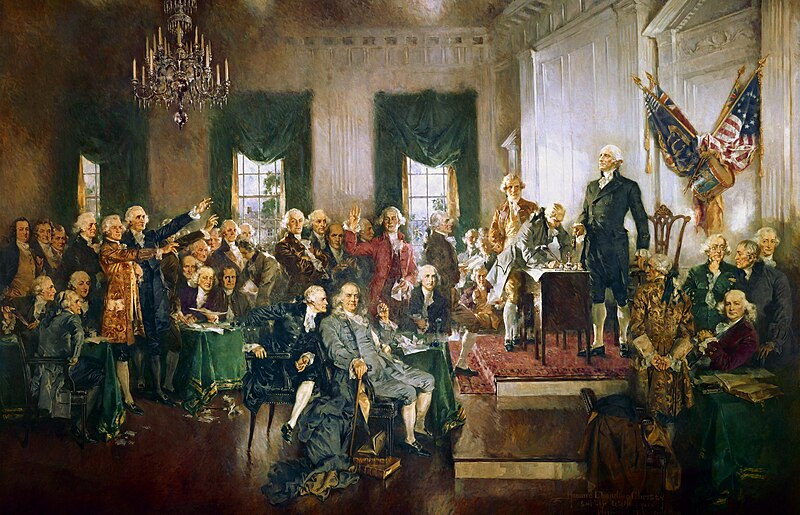
The election of 1800 was the first time in our history that religion was a presidential campaign issue: Federalist newspapers presented the choice of “God--And a religious president” or “Jefferson--And no God” (Ferling, 154). The First Amendment guarantees freedom of religion and speech. Candidates are free to speak of their religion; and voters may ask as many religious questions as they please. Voters tend to choose a candidate with a worldview similar to their own, and religion--or lack of religion--is a major ingredient in every worldview; hence, religion always will be a campaign issue. The people are the only proctors of this religious test, and, unfortunately, candidates often approach hypocrisy in search of a good score. Regardless of the candidate’s answers, voters need wisdom to grade the papers of each candidate. 

Do Christian candidates necessarily make good presidents? Ostensibly, we have never had a non-Christian president. In the election of 2000, Al Gore said he decides important questions by asking himself “What would Jesus do?” George W. Bush declared that his favorite philosopher is “Christ, because he changed my heart” (Dionne, 173).

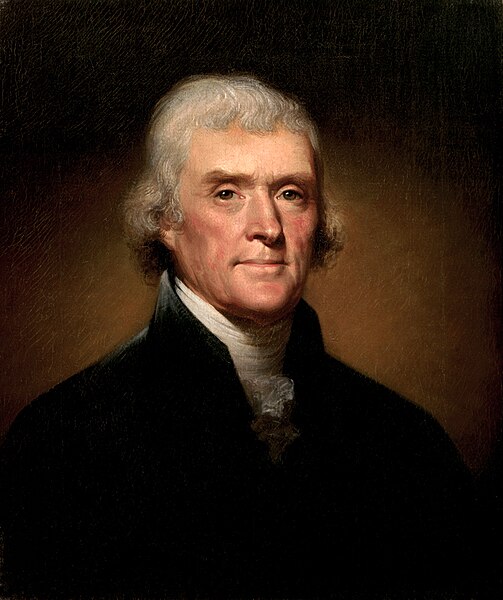
During the election of 1800, Jefferson was accused of infidelity for saying, “It does me no injury for my neighbor to say there are twenty gods or no God. It neither picks my pocket nor breaks my leg.” However, Jefferson said, “God, who gave us life, gave us liberty. Can the liberties of a nation be sure when we have removed their only firm basis, a conviction in the minds of the people, that these liberties are a gift from God?” John Adams signed the Treaty of Tripoli declaring “The Government of the United States of America is not…founded on the Christian religion.” But, John Adams said, “Our Constitution was made only for a moral and religious people. It is wholly inadequate to the government of any other.” The verdict of Jefferson and Adams is clear: our government is not religious; only people can be religious. Federalists warned Christians that they would have to hide their Bibles if Jefferson were elected (Ferling, 154), but Jefferson stood for “limited [government] powers, no eternal wars, free commerce, and liberty” (Ferling, 127). Jefferson was elected and Americans enjoyed greater liberties, not persecution; many Democratic-Republicans were released from prison with the repeal of the Alien and Sedition Act (Ferling, 110). Roger Williams said, “Christ Jesus never called for the Sword of Steel to help the Sword of the Spirit,” and he believed that non-believers could manage the affairs of state as well as believers (Lambert, 89).
 
John Adams and Thomas Jefferson
Though Christ never called on the sword of steel to help the Sword of the Spirit, the devil has often called on the sword of religion to aid the sword of steel. Machiavelli wrote, “Never was there a promulgator of extraordinary laws in a nation who did not invoke God’s authority.” The twenty fourth point of the Nazi’s “unalterable party program” proclaimed that they stood for positive Christianity. In what Hitler called a “state of order, freedom, and law,” soldiers wore “God with us” on their belt buckles, and true religion was suppressed under a façade of religion. The Nazis did not practice what they preached.     

Many political aspirants have good intentions. Daniel Webster said, “The Constitution was made to guard the people against the dangers of good intentions. There are men in all ages who mean to govern well, but they mean to govern. They promise to be good masters, but they mean to be masters.” These well intentioned politicians claim to worship God, while advocating an adulterous marriage of Church and State and declaring that “The State is god.” Claiming to separate Church and State, they kick God out of government. Actually, they marry the Church (people) to a new god, State. The Bible says, “God will supply your every need” (King James Version, Php. 4.19). They promise, “The government will supply your every need.” God says, “I am the God that healeth thee” (King James Version, Exod. 15.26). These politicians promise, “The government will supply your health care.” God says, “I have cared for you since you were born. Yes, I carried you before you were born. I will be your God throughout your lifetime--until your hair is white with age. I made you, and I will care for you.” (New Living Translation, Isa. 46.3-4). They promise, “The government will care for you from cradle to grave.” When we say the government should not take on God’s responsibilities, we do not say that government has no responsibilities; government must implement justice. We must understand that “to tamper with man’s freedom is not only to injure him, to degrade him, it is to change his nature, to render him, in so far as such oppression is exercised, incapable of improvement; it is to strip him of his resemblance to the Creator, to stifle within him the noble breath of life with which he was endowed at his creation” (Bastiat, 534). 
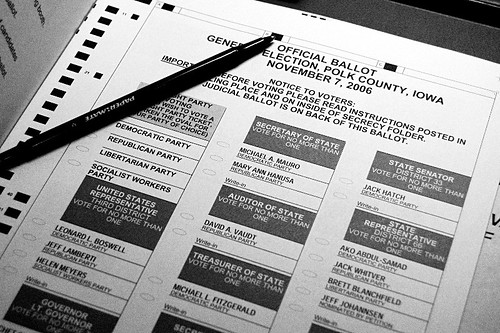
ballot
via Flickr
We must elect candidates devoted to defending religious liberty. Benjamin Franklin explained, “Only a virtuous people are capable of freedom. As nations become corrupt and vicious, they have more need of masters.” Tocqueville said, “[Champions of freedom] should hasten to invoke the aid of religion…without morality, freedom cannot reign, and without faith, there is no basis for morality” (Tocqueville, 12); he also observed, “Only God can be all powerful without danger, because his wisdom and justice are always equal to his power” (Tocqueville, 290). We must preserve economic freedom if we would preserve religious freedom; as Von Mises says, “In a system where there is no [free] market, where the government directs everything, all those other freedoms are illusory, even if they are made into laws and written in Constitutions” (Von Mises, 18). In Revelations, we see that an economic sanction forbidding buying or selling without the mark of the beast greatly injured religious liberty. We would do well to follow Patrick Henry’s advice to “guard with jealous attention the public liberty. Suspect everyone who approaches this jewel.”  

My vote last election was not cast because Barack Obama belongs to the United Church of Christ, Romney is a Mormon, Paul is a Baptist, or Santorum and Gingrich are Catholics. I voted for the candidate whom i believe stood firmly for liberty. John Winthrop wrote, “There is a civil and moral liberty…which it is the mission of power itself to protect: this is the liberty to do that which is just and good without fear. This sacred liberty we must defend in all circumstances and, if necessary, risk our life for it.” Winthrop was willing to risk his life to defend liberty; we can, at least, give our votes for liberty. Let’s be trustworthy voters; let’s choose candidates whose lives are sermons*. Let’s choose candidates who practice what they preach.  

What I Learned From Westerns: Gun Control

Wednesday, April 17, 2013

Movies, shows, and books are created with a purpose.  The screenwriter/author wants to get a point across, and while you may be watching/reading just for entertainment, the screenwriter is trying to give you a message--perhaps good, perhaps bad.

One recurring message I've noticed in old Westerns is about the dangers of gun control.

The Rifleman: The Anvil Chorus
     This show demonstrates that although gun control may be first instituted with good intentions, people with bad intentions can quickly use the situation for their own good.


"Laws that forbid the carrying of arms...disarm only those who are neither inclined nor determined to commit crimes...Such laws make things worse for the assaulted and better for the assailants; they serve rather to encourage than to prevent homicides, for an unarmed man may be attacked with greater confidence than an armed man."  --Cesare Beccaria (Crimes and Punishment)

Wanted Dead or Alive: The Tyrant

"One of the ordinary modes, by which tyrants accomplish their purposes without resistance, is, by disarming the people, and making it an offense to keep arms."  --Joseph Story, 1840

"To disarm the people... was the best and most effectual way to enslave them."  --George Mason


"Guard with jealous attention the public liberty. Suspect every one who approaches that jewel. Unfortunately, nothing will preserve it but downright force. Whenever you give up that force, you are inevitably ruined."  --Patrick Henry


 In most towns in the old Westerns where gun control was enforced, it was enforced because a gang was in power and they were afraid an armed populace would take away their power: see also Black Saddle: Client Travers and (Part 2)

Throughout history when wicked men who want to enslave the populace and enjoy complete power are in authority, they do institute gun control.  For example, Nazi Germany under Hitler instituted the 1938 German Weapons Act.  

I could go on about the importance of the Second Amendment and man's inherent right to self-defence, but this post is mainly for the benefit of those who already acknowledge these rights.  As we approach another anniversary of the "Shot heard Round the World" fired at Lexington green in resistance to the British attempt to confiscate arms from Americans, I thought it was great to see a few shows from back in the good old days when propaganda went the other way.

In closing, enjoy this Glock commercial.  With an armed populace, criminals don't appear to stand much of a chance.


"Today, we need a nation of Minutemen, citizens who are not only prepared to take arms, but citizens who regard the preservation of freedom as the basic purpose of their daily life and who are willing to consciously work and sacrifice for that freedom."-- John F. Kennedy

In God We Trust

Thursday, February 21, 2013


In Memoirs of the Second World War, by Winston Churchill, I recently read about how Adolf Hitler took control of Germany.  Hitler came to power completely legally.  The citizens, suffering from unemployment and trying to recover from hyperinflation, voted for the Nazis.  A few months later, the Reichstag majority voted 441 to 94 to give Hitler complete “emergency” powers for the next 4 years. 

It seems that since the famine in Joseph’s days, whenever there is an “emergency,” people sell themselves and their inherent, God-given rights to Pharaoh (Genesis 47:18-19).  The same scenario is repeated in the first book of Samuel.  God had delivered the Israelites from all their enemies, but when there was an “emergency”—when Nahash the king of the Ammonites came—the Israelites cried, “Give us a King!”  They did not realize that God was their King.  He was their banner, Jehovah-Nissi (Exodus 17:5) who fought their battles.  He is Jehovah-Jireh, the God who provides.  He was the Lord their Healer, the Lord their peace, God Almighty.  But no, they wanted a Pharaoh of their own, an earthly, tangible, fallible king.  Samuel warned the people that they would lose their freedoms and become servants, slaves to their king.  The Israelites got what they asked for—King Saul.

History often repeats itself.  In 1932, the people of Germany were in trouble.  Who did they turn to?  God, their Father?  No!  They turned to their Pharaoh—their government.  Portraits of the Fuehrer (Father) were posted in churches, and preachers were ordered to praise the Fuehrer Hitler in their churches.  Most obeyed and became unwitting adherents to the reprehensible doctrine—unspoken but de facto—that “The state is God.”  They lost their liberties and got the “Fuehrer” Adolf Hitler, a tyrant.  

And yet even today so many people in these United States are completely blinded.  After every disaster or emergency, the government takes more power under the pretense of keeping us safe.  They forget the words of Benjamin Franklin, “Those who would give up essential liberty to purchase a little temporary safety, deserve neither liberty nor safety.”  

During the Great Depression, many were unemployed, and some were going hungry.  Who did the people turn to?  The government, of course.  And in the 80 or so years since then, every time there is a little “Emergency” anywhere, they always do the same thing.  The nature of the people is predictable.  They forget “The Lord will provide” and demand that the government provide.  They have lost their strong, resilient, and independent spirit in a large part.  Like Esau, selling his birthright for a bowl of pottage, like the Israelites desiring a king, and like the Egyptians selling themselves to Pharaoh for food, many of the people are willing to sell their birthright of liberty for bowls of entitlements.  

On all of our coins, our motto is written, "In God we trust."  Do the people of these United States really trust in God?

I Declare! What it took to declare our independence

Thursday, October 4, 2012

This essay was orginally written for the Joe Foss Institute Essay Contest, I Declare.

     The Founding Fathers valued liberty and justice more than life. They believed the purpose of government is to secure the unalienable rights of life, liberty, and the pursuit of happiness, and that whenever any government becomes destructive to these ends, the people have the right and responsibility to God and posterity to alter or abolish it. The Founders saw a long train of abuses of power, all designed to reduce them to despotism. They appealed to the Supreme Judge of the world, mutually pledged their lives, fortunes, and sacred honor, and fought for, died for, and built a better future for posterity.

     The signers of the Declaration of Independence were young men, except for Benjamin Franklin who assured his fellows, “We must all hang together, or assuredly we shall all hang separately.” Three of the signers were in their twenties and eighteen were still in their thirties. They had wives and children. If they would only avoid the threat of hanging, they certainly would have many more years to live. But what good would life do them if the sacred flame of liberty were extinguished within their hearts? They pledged their lives.

     Thomas Nelson Jr. offered a bounty to the first American gunner to hit his own home—the most prominent house in Yorktown—which, he was certain, was British headquarters. He ordered his own hard-earned wealth destroyed. Eleven of the signers were prosperous merchants; one owned the largest mercantile house in America. Twenty four were lawyers or jurists; others were doctors, career politicians, and a minister. Rather than continue to live ordinary lives, become richer, and enjoy a comfortable retirement, they pledged their fortunes.

     “Our declaration of Independence, I dare say, you have seen,” Abraham Clark wrote to a friend ten days after signing the Declaration, “a few weeks will probably determine our fate. Perfect freedom or absolute slavery….our fates are in the hands of an Almighty God.” Many contemporaries may not have viewed their “treason” as honorable, but the founders pledged their sacred honor, and they did not look back. No, Abraham Clark did not even look back when he heard a heavy knock on the door. A breathless messenger gave him a message from the British: they had captured two of his sons, and if he would renounce his signature on the Declaration of Independence, both would be freed. One son, Captain Thomas Clark, was held in a dungeon of the notorious prison ship Jersey. No food was given him except for the bread fellow prisoners managed to smuggle to him through a keyhole. Abraham Clark refused to compromise. For seven long years the founders fought for liberty. They struggled, they never looked back, and they won.

     What did it take to declare our independence? Independence of mind: the founders knew that eternal vigilance is the only way to preserve freedom. As Charleton Heston said, "If Americans believed in political correctness, we'd still be King George's boys--subjects bound to the British crown." If we would be free, our minds must be freed from conventional indifference. We must declare our independence with every heartbeat, with every thought, with every action, and with every jot and tittle we read or write. The founders protested the smallest infringements of liberty because they knew that a small infringement always leads to a larger one; as James Beck said, the Founding Fathers “waged a 7-year war in protest against a two penny tax on a pound of tea, because it involved a principle.” The founders took their responsibility to posterity seriously. They asked themselves, “What kind of inheritance will we hand down to future generations?”

They refused to pass on to their children a giant British debt incurred by wars. They refused to shackle their children as slaves to taxation without representation. They refused to leave to their children a country where justice was not executed and where the king had “erected a multitude of new offices, and sent swarms of officers to harass our people, and eat out their substance.” They would not leave to future generations a country where standing armies were kept in peacetime, unreasonable searches and seizures were conducted, and citizens were deprived of trial by jury. They had faith for a better future; they believed in a beautiful America where liberty and justice would prevail. They did the impossible; they declared independence from what was then the greatest nation on earth. They had an ideal; they stuck with their principles. Their ideal became a reality; it became the United States of America, the land of the free and the home of the brave.

     Today, are we proud of the inheritance we will pass on to future generations? Will we pass on to our children the great America, the beautiful America, the noble America that was passed on to us? Will we make the Founding Fathers proud? “Posterity,” wrote John Adams, “you will never know how much it cost the present generation to preserve your freedom. I hope you will make good use of it. If you do not, I shall repent in heaven that ever I took half the pains to preserve it.” You, reader, are “posterity.” The spirit of 1776 must live within your heart. As Dwight D. Eisenhower said, “Freedom has its life in the hearts, the actions, the spirit of men and so it must be daily earned and refreshed--else like a flower cut from its life-giving roots, it will wither and die.” You must protest the smallest infringement of liberty because the smallest infringement will always be precursor to a larger one.

     Thomas Jefferson gave three provisions for the preservation of liberty. First, “Educate and inform the whole mass of the people. Enable them to see that it is their interest to preserve peace and order, and they will preserve them…[The people] are the only sure reliance for the preservation of liberty.” Educate yourself in the works of the Founding Fathers. Study books such as Democracy in America (Tocqueville), The Law (Frederic Bastiat), and the works of Von Mises and Hayek. Share your love for liberty in essays, Facebook posts, letters to editors, blog posts, town hall meetings, and everyday conversations with friends and neighbors. Make your own personal declaration of independence: let the whole world know “I declare! I will preserve the principles of the Founding Fathers! I will pass on the torch of liberty to my friends, my family, and future generations!” For the preservation of liberty, pledge your life.

     Second, Jefferson said, “[The people] are our dependence for continued freedom. And to preserve their independence, we must not let our rulers load us with perpetual debt…” You must set a good example by keeping your own budget balanced. Do not burden yourself with a large debt which will be difficult to repay. Debt is oppressive on a personal level; it can be even more oppressive on a national level. The British levied taxes on the colonies to pay the debts incurred during the French and Indian wars, and this taxation without representation drove the Founding Fathers to call for independence. We must not pass on a 15 trillion dollar debt to our children. As voters, we must support candidates who will substantially reduce the national debt, that “fore-horse of misery and oppression” (as Jefferson called it). Declare your independence from debt, pledge your fortunes; you have everything to gain and nothing to lose. Third, "Can the liberties of a nation be sure when we remove their only firm basis, a conviction in the minds of the people, that these liberties are a gift from God?” Jefferson asked. Without faith in God, we will quickly become disillusioned. People fail, governments fail, we fail, but God never fails. He is the One who gave us liberty, and it is His will that we preserve it. Without His help we can do nothing. Our future is the gift of God, and we can be confident when we place our future in His hands. As Abraham Clark said, “Our fates are in the hands of an Almighty God, to whom I can with pleasure confide my own; He can save us, or destroy us; His councils are fixed and cannot be disappointed, and all His designs will be accomplished.” We must declare independence from immoral inclinations and pledge our sacred honor to the work of God. If we follow where God leads us and if we do His will, we will never be disappointed.

     Today, as I see a giant and growing bureaucracy devouring our tax dollars and stifling the free market by enforcing numerous unnecessary regulations upon the American people, I realize more than ever that we need an awakening at the voting booths. We need an awakening in our check books, and most of all, we need an awakening in our hearts. We do not need the government to care for us from cradle to grave. We must not exchange any of our essential liberties for a little temporary safety. We need a revitalization of justice. We need freedom to make our own decisions, and we must take responsibility for the results. We are Americans. We must pledge our lives, fortunes, and sacred honor. Stand with me, stand with the Founding Fathers and proclaim, “We declare! We will not pass on to posterity an inheritance of which we would be ashamed! I will preserve liberty and fight for freedom. I declare!”

Note:  You should warn others when they are on the wrong course, but you cannot expect others to listen to you; you cannot stake your life and future on it.  Believe me; nothing is going to change for the better when it comes to the federal government.  Remember my post Live Unconventionally—declare your own independence, and don’t sink with the ship!

Book Review: Nation, State, and Economy

Monday, April 23, 2012

Nation, State, and Economy (Nation, Staat, and Wirtshaft) was written by Ludwig von Mises in 1919--at the same time as Keynes wrote The Economic Consequences of Peace.  Translated by Leland B. Yeager, the book was published by New York University Press in 1983.  If you’re addicted to reading Von Mises’ books (like I am), there’s no reason not to read it; but I would not recommend the book for beginners.  This is one of Von Mises’ earlier works, and his theories had not yet matured.

To start the book, Mises urged everyone to go on with life instead of living in eternal remorse over World War 1.  People should, however, learn from the disaster and never repeat their errors: “Every person must take his life and every nation must take its history as it comes; nothing is more useless than complaining over errors that can be no longer rectified, nothing more vain than regret.”  “Nations,” he says, “like individuals, become wise only through experience, and only through experience of their own.”  

Mises believes that nations are not based on geographic or political boundaries, but rather on language because language affects the thought process.  “Community of language binds and difference of language separates persons and peoples,” he says.  

Democracy doesn’t work well, he observed, in a state with a nationally mixed population (I.e. with strong ethnic groups which have not been assimilated).  “In polyglot territories, the application of the majority principle leads not to the freedom of all, but to the rule of the majority over the minority.”  The struggle of nationalities for control will only “lose sharpness to the extent that the functions of the state are restricted and freedom is extended.”

Von Mises goes on to international affairs.  War, Mises observes, was always caused by one thing, greed for power.  Philanthropic pacifism wants to abolish war without getting at the causes of war.  The League of Nations and any extensive efforts at arbitration will fail, Mises predicted.  Methods such as a socialist world community would not eliminate problems; they are utopian.  “Whoever wants peace among nations,” he declares, “must seek to limit the state and its influence most strictly.”  Mises rejects war not on philanthropic grounds but from the standpoint of utility: war lowers the standard of living.  An increase in wealth never results from destruction.  Free people who are busy with their own business do not want war, but the “‘statification’ of life and of the economy necessarily leads to the struggle of nations.”  Von Mises explores the pre-war conditions in Germany and Austria and the reasons an authoritarian government was able to take power.  He then notes that the development of the spatial division of labor and progress toward a world economy works “more effectively for peace than all the efforts of the pacifists.”

“Inflation,” von Mises wrote, is an indispensable intellectual means of militarism.  Without it, the repercussions of war on welfare would become obvious much more quickly and penetratingly; war-weariness would set in much earlier.”  During World War I, inflation messed up balance sheets because the depreciation of money was not accounted for. “The inflation drew a veil over capital consumption.  The individual believed that he had become richer or had at least not lost, while in truth his wealth was dwindling.  The state taxed these losses of individual economic units as ‘war profits’ and spent the amounts collected for unproductive purposes.”  Everyone fell into ecstasy, thinking they had made a lot of money off the war, while their standard of living dropped.

Von Mises goes on to contrast socialism and liberalism (the old liberalism, nearly the opposite of modern day liberalism, was a belief in liberty).  Both Socialism and liberalism strive for the same goal (general welfare); they both seek for “the greatest happiness of the greatest number.”  The only difference is in the methods they choose to reach the goal.  Liberalism calls for free trade internationally, not for the sake of foreigners, but for the sake of one’s own people.  It calls for free trade at home, “not out of regard for particular classes, but for the welfare of all.”  Mises says, “An economic order resting on private ownership of the means of production and according the greatest possible scope to the activity and free initiative of the individual assures…the attainment of the goal…The socialist…seeks to attain it by socialization of the means of production…In the socialist society, the distinction between rich and poor would fall away; no one would possess more than another, but every individual would be poorer than even the poorest today, since the communist system would work to impede production and progress.”  Waste, he explains, is rampant in public services and enterprises, while private enterprise is highly efficient.  Socialism cannot be defended rationally, Mises claims, it is more like a doctrine of salvation.  “Yet, the Kingdom of Christ is not of this world; socialism, on the contrary, wants to establish the kingdom of salvation on earth.  Therein lies its strength, therein, however, its weakness too, from which it will collapse some day just as quickly as it has triumphed.  Even if the socialist method of production really could raise productivity and provide greater welfare for all than the liberal method, it would be bound bitterly to disappoint its adherents, who also expect the highest exaltation of the inner feeling of happiness from it.  It will not be able to remove the inadequacy of everything earthly…it will have to recognize that a religion not referring to the life to come is an absurdity.”

On the other hand, von Mises explains some of the essential points of liberalism, “If they deny to the state the mission of furthering the realization of the values of life, they do so not out of want of esteem for true values, but rather in the recognition that these values, as the most characteristic expression of inner life, are inaccessible to every influence by external forces.  Not out of religiosity do they demand religious freedom, but out of deepest intimacy of religious feeling, which wants to make inner experience free from every raw influence of outward power.  They demand freedom of thought because they rank thought much too high to hand it over to the domination of magistrates and councils.  They demand freedom of speech and of the press because they expect the triumph of truth only from the struggle of opposing opinions.”

Mises then writes of the great influence oppression can have in the “modern” world (of 1919).  He speaks of how it is so easy to kill and control so many, of how one pressing one button could kill “thousands.”  [Just think of the extent of destruction a war or oppression could create today with nuclear weapons and so much more technology.]  Von Mises said that, “Only one external limit is posed to this rage for destruction.  In destroying the free cooperation of men, imperialism undercuts the material basis of its power.  Economic civilization has forged the weapons for it.  In using the weapons to blow up the forge and kill the smith, it makes itself defenseless in the future.  The apparatus of the economy based on division of labor cannot be reproduced, let alone extended, if freedom and property have disappeared.  It will die out and the economy will sink back into primitive forms.   Only then will mankind be able to breathe more freely.  If the spirit of reflective ness does not return sooner, imperialism and Bolshevism will be overcome at the latest when the means of power that they have wrested from liberalism will have been used up.”  

Mises then concludes by affirming the rights of self-defense.  A war in self-defense is a “just war” and “the most virtuous person cannot live in peace if that does not please his evil neighbor.”  Then he goes on to tell us that everyone, even the most evil leader, has claimed to exercise power for the “general good.”  But basically, as Lord Acton said, “Power tends to corrupt and absolute power corrupts absolutely.”

I’m glad I read Nation, State, and Economy.  It definitely contains plenty interesting ideas and food for thought.

Freedom of Religion and Equality in Educational Choices

Friday, April 13, 2012

A young girl walks to school every day--5 steps to her desk--where she is soon absorbed in her studies. She is an evangelical Christian homeschooler. School is out when she finally dozes off with a classic by her side and pen and notepad slipping from her grasp. She never misses a day of school for snow, sleet, wind, or rain. Though her rights to free exercise of religion are challenged by the public schools, her entrance into the portals of knowledge has been expedited by her alternative. It is impossible for public schools to provide satisfactory religious consideration for a very diverse populace, as “a general state education is a mere contrivance for molding people to be exactly like one another” (Hayek, 376). Equal consideration of all views can be achieved fairly only through eliminating public funding, localizing education and reducing public schools to equal footing with parochial and home schools.

The first amendment reads in part, “Congress shall make no law respecting an establishment of religion, or prohibiting the free exercise thereof.” This was, at first, solely a restriction on the federal government (Permoli v. First Municipality 1845), and therefore the restriction had no influence on the schools because the federal government had no power over education (10th amendment) (Federalist No. 84). In his 6th annual address, Jefferson addressed the problem of a debt-free nation that was accumulating a surplus with the proposal that federal funding be extended to education. Education would not be taken out of the “hands of private enterprise, which manages so much better all the concerns to which it is equal,” but an amendment to the Constitution was deemed necessary “because the objects now recommended are not among those enumerated in the Constitution, and to which it permits the public moneys to be applied.” (Richardson, Vol. I, 409-410). The suggested amendment was never passed.

But while courts have overlooked Jefferson’s official remarks about the constitutionality of federal funding of education, they have placed much stock in Jefferson’s interpretation of the First Amendment as a wall of separation between church and State, found in a letter to the Danbury Baptist Association (Jefferson, 332). Up to nearly fifty years after the first amendment, there is little evidence of a wall of separation in the public schools. State schools were non-sectarian, but ultimately Protestant (Parsons, 60). Washington’s admonition was heeded: “Let us with caution indulge the supposition that morality can be maintained without religion…It is substantially true that virtue or morality is a necessary spring of popular government…Promote, then, as an object of primary importance, institutions for the general diffusion of knowledge” (Richardson, 220). Jefferson’s slight of the Bible in suggesting that young students whose “judgments [were] not mature enough for religious inquiry” would profit more by reading Greek, Roman, European, and American history” (Lambert, 227) was temporarily forgotten. As Tocqueville observed in the early nineteenth century: “In America, it is religion which leads the way to enlightenment; it is the observance of divine laws which leads man to liberty” (Tocqueville, 30).

The 14th amendment, ratified in 1868, extended the first amendment to the states. By then, the Zeitgeist had changed. In his 7th annual message, President Grant recommended that an amendment be submitted for ratification, making it the duty of each of the States to maintain public “schools adequate to the education of all the children…forbidding the teaching in the said schools of religious, atheistic, or pagan tenets; and prohibiting the granting of any school funds or school taxes, or any part thereof, either by legislative, municipal, or other authority, for the benefit or in aid, directly or indirectly, of any religious sect or denomination” (Richardson, Vol. VII, 334).

Of course, such an amendment was never passed, but, as Tocqueville states, “The peace, prosperity, and very existence of the Union rest constantly in the hands of seven [now nine] federal judges. Without them, the Constitution would be a dead letter” (Tocqueville, 169). In Everson v. Board of Education, the Supreme Court ruled that the establishment clause of the First Amendment forbids taxes to be raised in support of any school teaching religion. In Abington Township School District v. Schempp the Supreme Court ruled school-sponsored Bible reading in public schools in the United States to be unconstitutional. In Wallace v. Jaffree, the Supreme Court ruled that the State's endorsement of prayer activities at the beginning of each school day is not consistent with the “established principle that the government must pursue a course of complete neutrality toward religion.” In Kitzmiller v. Dover the teaching of intelligent design was banned from the classroom.

Do such rulings accommodate evangelical Christian students and teachers who are instructed to “Pray without ceasing,” (King James Version, 1 Thess. 1.17), “Go…into all the world [“all” does not exclude the classroom], and preach the gospel to every creature,” (Mk 16.15) and “Acknowledge Him in all your ways, and He shall direct your paths”(Prov. 3.6)? Do the rulings accommodate Christians who are taught that “the fear of the LORD is the beginning of knowledge” (Prov. 1.7), and who are instructed to “train up a child in the way he should go and when he is old he will not depart from it”? Not at all. Instead of Christianity, creationism, and the Bible, students are taught sociology and evolution, and are psychologically evaluated (Gross, 129-148). That is why my parents chose to home school me. I was taught to read from the King James Bible with prayer and Bible reading always an integral part of every school day.

It is just as impossible to satisfy everyone with the public schools as it is to return the schools to the teaching of piety. America is now a far more diverse nation than when the Constitution and First Amendment were written. Everyone has his or her own interpretation of how a child should be raised and what he or she should be taught. As F.A. Hayek adeptly observed: “Very few of the problems of education are scientific questions in the sense that they can be decided by any objective tests. They are mostly either outright questions of value, or at least the kind of questions concerning which the only ground for trusting the judgment of some people rather than that of others is that the former have shown more good sense in other respects” (Hayek, 380). Perhaps the greatest enormity is that parents who opt out of the public school system and home school or send their children to parochial schools are compelled to furnish tax dollars for the propagation of opinions they disbelieve (Paul, 133), a practice Jefferson termed sinful and tyrannical.

Satisfaction that my rights to the free exercise of religion will be sufficiently protected will not come the day the King James Bible is studied in the public schools. That day will never come; but if it does come, my atheist and Jewish neighbors will cry that their rights have been abused. I myself would fear that the government would corrupt the church. Satisfaction that my right to the free exercise of religion is sufficiently protected will not come when Protestant teachings are re-introduced into the public schools. Anyone who believes that day will come is dreaming; but if it does come, my Catholic neighbors will cry of tyranny. To compel any man or woman, of whatever religious persuasion he or she be, to furnish money for the propagation of opinions he or she disbelieves is sinful and tyrannical. I will honor Jesus Christ with my life: “As for me and my house, we will serve the Lord.” But to everyone else I say, “Choose you this day whom you will serve,” but do not compel me to pay tribute to your god, opinions, or godless education. I am a Christian. My family is Christian. My children will be raised as Christians, and dearest to our hearts, shining eternally and in everything we do, will be the Light of the World, Jesus Christ, and His immortal gift of Liberty: the individual liberty which my forefathers sought to protect with the Bill of Rights and the eternal liberty of a conscience at peace with God.
_______________________
Works Cited:

Gross, Martin L. The Conspiracy of Ignorance: The Failure of the American Public Schools. New York: HarperCollins, 1999. Print.

Hamilton, Madison, and Jay. The Federalist. Ed. Wright, Benjamin F. New York: Barns & Nobles Books, 1996. 531-541. Print.

Hayek, Friedrich A. von. The Constitution of Liberty. Chicago: University of Chicago Press, 1960. Print.

Jefferson, Thomas. The Life and Selected Writings of Thomas Jefferson. Ed. Koch, Adrienne, and Peden, William. New York: The Modern Library, 1944. 332-333. Print.

Lambert, Frank. The Founding Fathers and the Place of Religion in America. Princeton N.J.: Princeton University Press, c2003. Print.

Parsons, Wilfrid. The First Freedom. New York: D. X. McMullen Co.,1948. Print.

Paul, Ron The Revolution: A Manifesto. New York: Grand Central Publishing, 2008. Print.

Richardson, James D. United States. Cong. Joint Committee on Printing. A Compilation of the Messages and Papers of the Presidents 1789-1897. 53rd Cong., 2nd sess. Washington: GPO, 1896. Print.

The Holy Bible: Authorized King James Version. Nashville, Tennessee: Holman Bible Publishers, 1998. Print.

Tocqueville, Alexis de. Democracy in America. Trans. Stephan Grant. Indianapolis, Ind.: Hackett Pub., c2000. Print.

Individual Liberty

Monday, March 19, 2012


Individual liberty was treasured more than life by the Founding Fathers. Benjamin Franklin warned that “those who would give up essential liberty to purchase a little temporary safety deserve neither liberty nor safety.” The founders knew that liberty could not be secured without law; they also amply realized the dangers of government oppression. That is why they established the Constitution and the Bill of Rights. It is essential that we diligently preserve this inheritance of liberty for which the Founders pledged their lives, fortunes, and sacred honor.


The Constitution institutes trial by jury and habeas corpus, and forbids the passage of bills of attainder or ex-post-facto laws. Some of the founders, including Alexander Hamilton, objected to the addition of a bill of rights, claiming the addition unnecessary since no power was given by which restrictions could be imposed. Thomas Jefferson disagreed, “A bill of rights is what the people are entitled to against every government on earth, general or particular; and what no just government should refuse or rest on inference…I hope, therefore, a bill of rights will be formed, to guard the people against the federal government.” The Bill of Rights was added, protecting freedom of religion, speech, the press, peaceable assembly, and the right to keep and bear arms and to be secure against unreasonable searches and seizures. The Founders were certain that “the natural progress of things is for liberty to yield and government to gain ground” (Jefferson), so they etched the provisions of liberty in stone and warned their children to “guard with jealous attention the public liberty. Suspect everyone who approaches this jewel” (Patrick Henry).


Accountability to no one but God in matters of conscience (freedom of religion), willingness to take risks and bear responsibility for the results, self-reliance (using the right to keep and bear arms for hunting and self-defense), readiness to back ones own convictions against a majority (utilizing freedom of speech and the press), and willingness to cooperate with ones neighbors in peaceable assemblage are the workings which exercise a person’s moral sense of responsibility. Should our minds wax dull through lack of exercising our freedoms, we could not be expected to choose our leaders responsibly.


Jefferson gave three provisions for the preservation of liberty. First, “Educate and inform the whole mass of the people. Enable them to see that it is their interest to preserve peace and order, and they will preserve them…[The people] are the only sure reliance for the preservation of liberty.” Today, I must educate myself in the tradition of liberty by studying the works of Founding Fathers and books such as Democracy in America (Tocqueville) and The Law (Frederic Bastiat). I can share my love for liberty in essays, letters to editors, Facebook posts, emails, internet forums, and conversations in the living room, at youth rallies, or town hall meetings. Second, Jefferson said, “[The people] are our dependence for continued freedom. And to preserve their independence, we must not let our rulers load us with perpetual debt…” I will set a good example by keeping my own budget balanced. As a new voter this election, I will support candidates who will substantially reduce the national debt, that “fore-horse of misery and oppression” (as Jefferson called it). Third, "Can the liberties of a nation be sure when we remove their only firm basis, a conviction in the minds of the people, that these liberties are a gift from God?” Jefferson asked. This conviction that liberty is an unalienable right--a gift from God--prompted Patrick Henry to cry “Is life so dear, or peace so sweet as to be purchased at the price of chains and slavery? Forbid it, Almighty God! I know not what course others may take, but as for me, give me liberty or give me death!” Only a moral people has the strength to sacrifice everything for liberty. I will trust in God. Finally, I will protest even the smallest infringement of liberty, for a small infringement is always the harbinger of a larger one. I will not support any legislation relieving individuals from personal responsibility; such legislation is anti-moral in effect and leads to an authoritarian government. Individuals tolerate difficulties if they have no one to blame but themselves. But if the government is responsible for providing healthcare and fails to provide efficiently; if the government is responsible for providing education and test scores drop; if the government is responsible for regulating business, instituting a minimum wage, and guaranteeing jobs and the people face chronic unemployment; if the government is responsible for stabilizing the economy and the economy is in the gutter, the people have no one to blame but the government. If the government fails, there will be discontent, protests, and perhaps revolution. The government will then be forced to marginalize individual liberties and will be rendered incapable of performing its basic duty, preserving justice.


"Posterity,” wrote John Adams, “you will never know how much it cost the present generation to preserve your freedom. I hope you will make good use of it. If you do not, I shall repent in heaven that ever I took half the pains to preserve it." Individual responsibility may sometimes be painful, but freedom is not available without it. In the words of Tocqueville: “What good does it do me, after all, if an ever-watchful authority keeps an eye out to ensure that my pleasures will be tranquil and races ahead of me to ward off all danger, sparing me the need even to think about such things, if that authority, even as it removes the smallest thorns from my path, is also absolute master of my liberty and my life; if it monopolizes vitality and existence to such a degree that when it languishes, everything must also sleep; and when it dies, everything must also perish.” We have no other choice, it’s liberty or death. Young people, Americans, let’s make good use of liberty. Let’s preserve liberty. Let’s make the Founding Fathers proud.


Many thanks to the Bill of Rights Institute for the great topic this year, and for permission to post my essay for the Being an American Essay Contest here!

Unalienable Rights?

Sunday, February 19, 2012


We hold these truths to be self-evident, that all men are created equal, that they are endowed by their Creator with certain unalienable rights, that among these are Life, Liberty, and the pursuit of Happiness…

For these rights, the Founders pledged their lives, fortunes, and sacred honor. Throughout the 238 years since, many men and women have claimed their God-given rights. But, unfortunately, some Americans now face discrimination of a type not seen before in the history of our great country.

Those discriminated against are skillful, alert, knowledgeable, and healthy American citizens who have done nothing illegal, but they cannot obtain drivers’ licenses (Iowa Code, section 321.182). As pariahs, it is illegal for them to marry (Iowa Code). Employment is closed to them, and revenues from self-employment/entrepreneurship must not exceed $400 if they are to escape the icy glare of federal penalties (IRS Code). They are young, talented, strong, and beautiful, but they are the untouchables. They are the numberless Americans. For the laws of our country have been re-written to declare:
We hold these truths to be evident, that only those men and women holding social security numbers are equal, that they have been endowed by the state with certain privileges, that among these are life (to the extent of everything needed to sustain it over $400 per year), liberty (to use one’s faculties in work, to enjoy the fruit of one’s labors, and marry), and the pursuit of happiness (at any speed greater than 5, 10, or 15 mph--depending on your greatest speed walking, running, or biking).

A Social Security Number? Do you mean to tell me that the inhabitants of these United States have made the Creator’s gifts of the unalienable rights of life, liberty, and the pursuit of happiness contingent on whether or not the young adult obtains a number, joining a system which itself predicts its own insolvency by 2038 and takes about 15% of a person’s life wages? Do you mean to tell me that the parents of these young Americans have so little faith in the abilities of their progeny that they would as soon see them die as opt-out of a degenerate social program designed 80 years ago by a man whose bones are now dry in his grave? Do they believe progress is impossible? Will they strangle the fresh youthful vigor and revitalizing initiative that could lead civilization on to heights of freedom and security? That is my nightmare, and I hope someone can wake me and show me that it really is just a bad dream--not the cold, hard truth.

But I also have a good dream. It’s called the American dream. And that dream is freedom and equality before the law.

Congress, some people have asked you for food stamps. You’ve given it to them. Some people have asked you for free healthcare and medicine. You’ve given it to them. Some people have asked for federal funding of the arts, museums, and schools. You’ve given it to them. Recently, some have asked for money to research how chess might help with executive control and academic achievement, and you, through the U.S. Dept. of Education have granted them $1,049,094. I don’t ask for a penny. I ask only for my unalienable, God-given rights: Life, Liberty, and the pursuit of Happiness. End this discrimination based on numbers. Let young people opt out of Social Security without becoming 2nd class citizens. Set the young Americans free at last.
DESIGNED BY ECLAIR DESIGNS